Boiler Repair Cost: What Hot Water Faults Can Reveal About Your System
A boiler problem rarely arrives at a convenient time. A loss of hot water before work, an unexpected fault code or a boiler that repeatedly switches off can quickly turn into a stressful situation.

Why you can trust our content
We understand that the boiler industry can be confusing, with plenty of outdated or misleading information. That’s why we rely only on trusted, proven sources to guide our advice and installations:
At a glance
One of the first questions homeowners usually ask is how much the repair will cost. The answer depends heavily on what has actually gone wrong. A simple component fault can be very different from a major repair on an older appliance.
Understanding what different hot water symptoms may indicate can help you approach repair decisions more confidently and recognise when a recurring fault deserves further investigation.
What affects boiler repair cost?
There is no single standard price for every boiler repair. The final amount depends on the fault, appliance, parts required and complexity of the work.
Common factors include:
- Type of boiler
- Fault being diagnosed
- Replacement parts
- Labour involved
- Boiler accessibility
- Appliance age
- Availability of components
- Whether the repair is urgent
- Whether additional faults are discovered
This is why a boiler repair cost estimate should ideally follow a proper assessment rather than being based only on a symptom.
A boiler that makes an unusual noise may need a very different repair from one that repeatedly loses pressure.
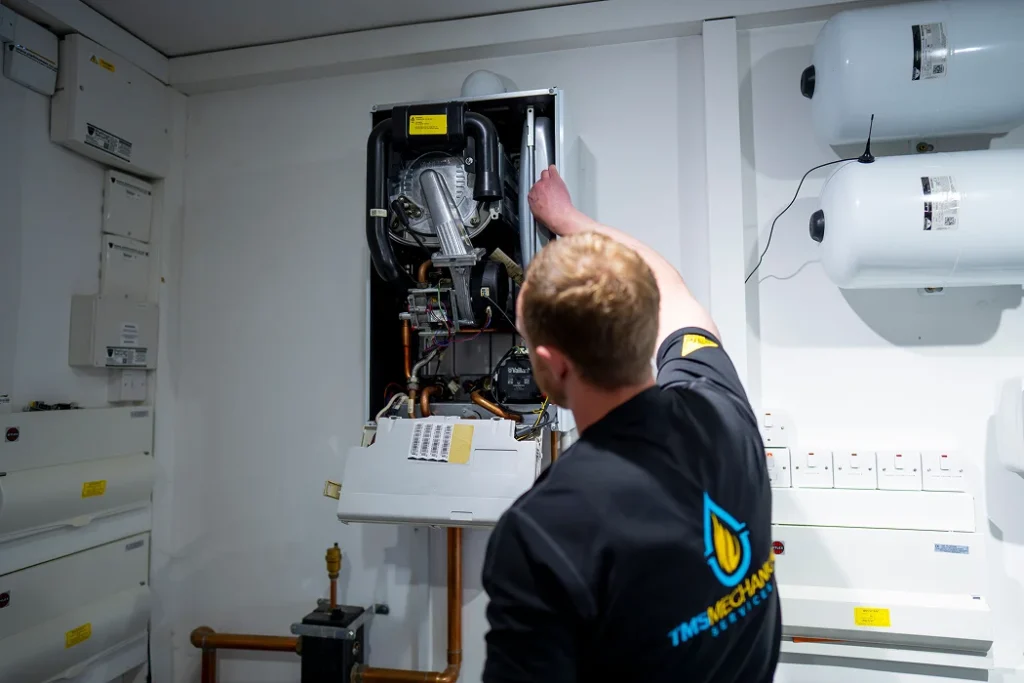
If your boiler is behaving differently from normal, TMS Mechanical Services can assess the symptoms and explain what may be required before repair work is carried out.
Which hot water faults can indicate a boiler problem?
Hot water faults can present in several ways.
You may notice that:
- The shower turns cold unexpectedly.
- Hot water takes longer to arrive.
- Water temperature fluctuates.
- Hot water works intermittently.
- The boiler displays a fault code.
- The boiler makes unusual noises.
- Hot water stops while heating continues.
These symptoms can have different causes, so it is important not to assume that one particular component is responsible.
For example, poor shower flow could be related to the incoming water supply rather than the boiler itself.
Why does the heating work when the hot water does not?
A combi boiler performs different functions for central heating and domestic hot water.
If a component associated with hot water operation develops a fault, the heating may continue to work normally.
Possible areas for investigation include:
- Diverter components
- Sensors
- Heat exchanger
- Flow switch
- Controls
- Electrical components
- Water supply
The exact cause needs to be established through proper diagnosis.
This is also why the boiler repair cost cannot always be determined from a telephone description of the problem.
Does boiler age affect repair decisions?
Yes.
An older boiler may still be perfectly repairable, but its age can become relevant when considering whether further spending makes sense.
For example, replacing one component on a well-maintained appliance may be reasonable. If the same boiler has suffered several faults recently, another expensive repair may prompt a discussion about replacement.
Other factors to consider include:
- Previous repair history
- Availability of parts
- Overall condition
- Efficiency
- Reliability
- Current household requirements
- Likely future repair needs
Repair should therefore be considered as part of the boiler’s overall condition rather than as an isolated expense.
Can water pressure problems increase repair costs?
Potentially, although pressure issues do not necessarily mean the boiler itself is faulty.
A sealed heating system has a working pressure range, and repeated pressure loss can indicate a leak, expansion vessel issue or another system problem.
On the hot water side, mains pressure and flow are separate considerations. A combi boiler depends on the incoming water supply, so poor shower performance may not be caused by the appliance.
An accurate diagnosis helps avoid paying for unnecessary repairs.
What type of boiler do you currently have?

Combi Boiler
Regular Boiler
System Boiler
Back Boiler
It just takes 60 seconds
And then you can book a free consultation
What are the common components that may need attention?
Different faults can involve different components.
| Symptom | Possible area of investigation |
| No hot water | Hot water controls or internal components |
| Fluctuating temperature | Sensors, flow or heat exchange |
| Unusual banging noise | Circulation or heat exchange issues |
| Repeated pressure loss | Heating circuit or related components |
| Boiler repeatedly locks out | Fault condition requiring diagnosis |
| Poor hot water flow | Water supply, plumbing or boiler |
| Heating works but hot water fails | Domestic hot water components |
These examples are not diagnoses. Several different faults can produce similar symptoms.
A qualified heating professional should determine the cause before recommending replacement parts.
Why can emergency repairs cost more?
Urgent callouts can involve different labour arrangements and availability from standard appointments.
If a boiler fails completely outside normal working hours, homeowners may need assistance at short notice, particularly during cold weather or when there is no alternative hot water source.
The emergency boiler repair cost may therefore differ from a planned repair appointment.
Before agreeing to emergency work, ask what the callout covers and whether additional labour or parts charges apply.
If the situation is not urgent, arranging a standard appointment may provide more flexibility.
If you have lost heating or hot water and need assistance, contact TMS Mechanical Services to discuss the problem and establish the appropriate next step.
Is a cheap repair always the best repair?
Not necessarily.
A low-cost repair can be excellent if it resolves an isolated fault on a reliable boiler. However, repeatedly replacing inexpensive components on an ageing appliance may not be the most cost-effective long-term approach.
For example, if a boiler has experienced several unrelated faults over a short period, another repair may only postpone the need for replacement.
A sensible decision considers the appliance’s condition, repair history and expected future reliability.
What should you ask before agreeing to a repair?
Before work begins, it is reasonable to ask:
- What is believed to be causing the fault?
- Does the boiler need a specific replacement component?
- Is the repair likely to restore reliable operation?
- Are parts readily available?
- Are there any other concerns with the appliance?
- How does the proposed repair compare with replacement?
- What is included in the quoted price?
Clear answers can help you understand whether you are paying for a one-off solution or maintaining an ageing system.
What does a typical repair situation look like?
Imagine a family home where the boiler still provides central heating but the hot water repeatedly cuts out.
An engineer checks the system and identifies a fault affecting hot water operation. The boiler is otherwise in reasonable condition, and there is no history of repeated breakdowns.
In this situation, repairing the faulty component may be a sensible option.
Now consider the same symptom on a much older boiler that has required several repairs over the previous year. The immediate repair may still be possible, but the homeowner may reasonably want to compare the cost with replacement.
The difference is not just the fault. It is the condition and history of the entire appliance.
When should you consider replacement instead?
Replacement may be worth discussing when repairs are becoming frequent, parts are difficult to source or the boiler no longer meets the household’s heating and hot water needs.
It may also be sensible when one major repair follows several smaller repairs within a relatively short period.
This does not mean every expensive repair requires a new boiler. The decision should be based on the likely value of repairing the current appliance compared with investing in a newer system.
(Link to related blog: When Should You Replace an Older Boiler?)
How can homeowners reduce the risk of unexpected repair bills?
Regular servicing can help identify developing problems and ensure the appliance continues to operate safely.
It is also useful to pay attention to changes in performance rather than waiting until the boiler stops completely.
Early warning signs can include:
- Increasingly noisy operation
- Slower hot water delivery
- Frequent pressure adjustments
- Repeated fault codes
- Radiators taking longer to heat
- Hot water temperature changes
Addressing concerns early does not guarantee that a major fault will be avoided, but it can make diagnosis and planning easier.
Looking at Repair Cost in Context
The price of a boiler repair is only one part of the decision. The type of fault, age of the appliance, previous repair history and expected future reliability all matter.
A sensible approach is to identify the underlying problem first, understand the likely repair and then consider whether maintaining the current boiler remains worthwhile.
TMS Mechanical Services can help homeowners understand hot water and heating faults and explain the available repair options.
If you are concerned about boiler repair cost, contact TMS Mechanical Services for professional advice and an assessment of the problem.
Related articles
What type of boiler do you currently have?
Combi Boiler
Regular Boiler
System Boiler
Back Boiler
At a glance
One of the first questions homeowners usually ask is how much the repair will cost. The answer depends heavily on what has actually gone wrong. A simple component fault can be very different from a major repair on an older appliance.
Understanding what different hot water symptoms may indicate can help you approach repair decisions more confidently and recognise when a recurring fault deserves further investigation.
What affects boiler repair cost?
There is no single standard price for every boiler repair. The final amount depends on the fault, appliance, parts required and complexity of the work.
Common factors include:
- Type of boiler
- Fault being diagnosed
- Replacement parts
- Labour involved
- Boiler accessibility
- Appliance age
- Availability of components
- Whether the repair is urgent
- Whether additional faults are discovered
This is why a boiler repair cost estimate should ideally follow a proper assessment rather than being based only on a symptom.
A boiler that makes an unusual noise may need a very different repair from one that repeatedly loses pressure.
If your boiler is behaving differently from normal, TMS Mechanical Services can assess the symptoms and explain what may be required before repair work is carried out.
Which hot water faults can indicate a boiler problem?
Hot water faults can present in several ways.
You may notice that:
- The shower turns cold unexpectedly.
- Hot water takes longer to arrive.
- Water temperature fluctuates.
- Hot water works intermittently.
- The boiler displays a fault code.
- The boiler makes unusual noises.
- Hot water stops while heating continues.
These symptoms can have different causes, so it is important not to assume that one particular component is responsible.
For example, poor shower flow could be related to the incoming water supply rather than the boiler itself.
Why does the heating work when the hot water does not?
A combi boiler performs different functions for central heating and domestic hot water.
If a component associated with hot water operation develops a fault, the heating may continue to work normally.
Possible areas for investigation include:
- Diverter components
- Sensors
- Heat exchanger
- Flow switch
- Controls
- Electrical components
- Water supply
The exact cause needs to be established through proper diagnosis.
This is also why the boiler repair cost cannot always be determined from a telephone description of the problem.
Does boiler age affect repair decisions?
Yes.
An older boiler may still be perfectly repairable, but its age can become relevant when considering whether further spending makes sense.
For example, replacing one component on a well-maintained appliance may be reasonable. If the same boiler has suffered several faults recently, another expensive repair may prompt a discussion about replacement.
Other factors to consider include:
- Previous repair history
- Availability of parts
- Overall condition
- Efficiency
- Reliability
- Current household requirements
- Likely future repair needs
Repair should therefore be considered as part of the boiler’s overall condition rather than as an isolated expense.
Can water pressure problems increase repair costs?
Potentially, although pressure issues do not necessarily mean the boiler itself is faulty.
A sealed heating system has a working pressure range, and repeated pressure loss can indicate a leak, expansion vessel issue or another system problem.
On the hot water side, mains pressure and flow are separate considerations. A combi boiler depends on the incoming water supply, so poor shower performance may not be caused by the appliance.
An accurate diagnosis helps avoid paying for unnecessary repairs.
What type of boiler do you currently have?
Combi Boiler
Regular Boiler
System Boiler
Back Boiler
It just takes 60 seconds
And then you can book a free consultation
What are the common components that may need attention?
Different faults can involve different components.
| Symptom | Possible area of investigation |
| No hot water | Hot water controls or internal components |
| Fluctuating temperature | Sensors, flow or heat exchange |
| Unusual banging noise | Circulation or heat exchange issues |
| Repeated pressure loss | Heating circuit or related components |
| Boiler repeatedly locks out | Fault condition requiring diagnosis |
| Poor hot water flow | Water supply, plumbing or boiler |
| Heating works but hot water fails | Domestic hot water components |
These examples are not diagnoses. Several different faults can produce similar symptoms.
A qualified heating professional should determine the cause before recommending replacement parts.
Why can emergency repairs cost more?
Urgent callouts can involve different labour arrangements and availability from standard appointments.
If a boiler fails completely outside normal working hours, homeowners may need assistance at short notice, particularly during cold weather or when there is no alternative hot water source.
The emergency boiler repair cost may therefore differ from a planned repair appointment.
Before agreeing to emergency work, ask what the callout covers and whether additional labour or parts charges apply.
If the situation is not urgent, arranging a standard appointment may provide more flexibility.
If you have lost heating or hot water and need assistance, contact TMS Mechanical Services to discuss the problem and establish the appropriate next step.
Is a cheap repair always the best repair?
Not necessarily.
A low-cost repair can be excellent if it resolves an isolated fault on a reliable boiler. However, repeatedly replacing inexpensive components on an ageing appliance may not be the most cost-effective long-term approach.
For example, if a boiler has experienced several unrelated faults over a short period, another repair may only postpone the need for replacement.
A sensible decision considers the appliance’s condition, repair history and expected future reliability.
What should you ask before agreeing to a repair?
Before work begins, it is reasonable to ask:
- What is believed to be causing the fault?
- Does the boiler need a specific replacement component?
- Is the repair likely to restore reliable operation?
- Are parts readily available?
- Are there any other concerns with the appliance?
- How does the proposed repair compare with replacement?
- What is included in the quoted price?
Clear answers can help you understand whether you are paying for a one-off solution or maintaining an ageing system.
What does a typical repair situation look like?
Imagine a family home where the boiler still provides central heating but the hot water repeatedly cuts out.
An engineer checks the system and identifies a fault affecting hot water operation. The boiler is otherwise in reasonable condition, and there is no history of repeated breakdowns.
In this situation, repairing the faulty component may be a sensible option.
Now consider the same symptom on a much older boiler that has required several repairs over the previous year. The immediate repair may still be possible, but the homeowner may reasonably want to compare the cost with replacement.
The difference is not just the fault. It is the condition and history of the entire appliance.
When should you consider replacement instead?
Replacement may be worth discussing when repairs are becoming frequent, parts are difficult to source or the boiler no longer meets the household’s heating and hot water needs.
It may also be sensible when one major repair follows several smaller repairs within a relatively short period.
This does not mean every expensive repair requires a new boiler. The decision should be based on the likely value of repairing the current appliance compared with investing in a newer system.
(Link to related blog: When Should You Replace an Older Boiler?)
How can homeowners reduce the risk of unexpected repair bills?
Regular servicing can help identify developing problems and ensure the appliance continues to operate safely.
It is also useful to pay attention to changes in performance rather than waiting until the boiler stops completely.
Early warning signs can include:
- Increasingly noisy operation
- Slower hot water delivery
- Frequent pressure adjustments
- Repeated fault codes
- Radiators taking longer to heat
- Hot water temperature changes
Addressing concerns early does not guarantee that a major fault will be avoided, but it can make diagnosis and planning easier.
Looking at Repair Cost in Context
The price of a boiler repair is only one part of the decision. The type of fault, age of the appliance, previous repair history and expected future reliability all matter.
A sensible approach is to identify the underlying problem first, understand the likely repair and then consider whether maintaining the current boiler remains worthwhile.
TMS Mechanical Services can help homeowners understand hot water and heating faults and explain the available repair options.
If you are concerned about boiler repair cost, contact TMS Mechanical Services for professional advice and an assessment of the problem.
Related articles
What type of boiler do you currently have?
Combi Boiler
Regular Boiler
System Boiler
Back Boiler